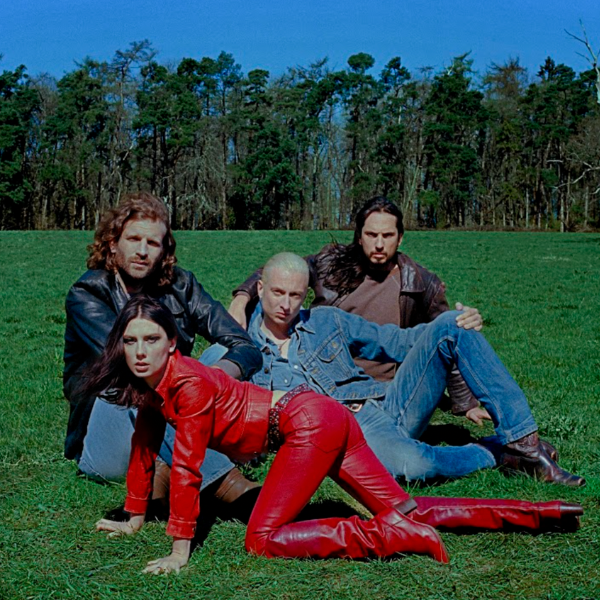
Wolf Alice on finding alchemy
Interviewed by Martha Brooke
All bands have to start somewhere. For Wolf Alice, like many before them, that somewhere took shape in sticky-floor basement gigs across North London—a proving ground to test the waters and see whether what they had might stick. From the outset, debut tracks Every Cloud and Fluffy pulled listeners into a melancholy, dreamlike haze, and it quickly became clear there was no one else quite like Wolf Alice.
Perhaps it's this ability to evade pigeonholing—a rare and commendable feat—that best explains the band's success. More than a decade on, the foursome remain tightly knit, defying the all-too-common curse of band dispersion, while holding fast to the Wolf Alice sound: one that still resists easy definition, no matter how hard you try to pin it down.
Now, with the release of their fourth studio album, The Clearing, that sound feels more emotionally charged and genre-defying than ever. Delicate in both lyricism and delivery, yet laced with an undeniable ferocity, the record lands like an anarchy-fuelled sucker punch to the chest. It mirrors the band's live presence, too—frontwoman Ellie Rowsell and bassist Theo Ellis fully surrendering to the sound, all visceral movement and raw instinct one moment, before softening into quieter, doe-like vulnerability the next.
In this conversation, ahead of last month’s return to New Zealand for Laneway Festival, the band talks about evolution, experimentation, and the quiet alchemy that keeps Wolf Alice unmistakably themselves.
You've managed to avoid being pigeonholed in a way very few bands do. When making The Clearing, what kept the music feeling distinctly Wolf Alice, even as you explored new genres and sounds?
{THEO} The four of us. I think even when we are reaching for something slightly new or different, at its essence, things will always sound like a version of us. There is also some weird alchemy we know when a song is ‘right’ or finished, and that decision, made only by us, may mean we have some telepathy.
In genre exploration, how do you balance artistic growth with listeners who might be nostalgic for Wolf Alice's earlier sound?
{JOEL} It's trickier than I was expecting. Honestly, though, we aim to make music that the four of us can stand by proudly and love to play on stages around the world. We've got an open-minded fan base that not only appreciates the many musical directions we've taken on our past albums, but also recognises that we are a band always trying to evolve and move forward.
What does the new album say about where Wolf Alice are right now—musically, and as a band who've grown up together?
{JOFF} It says that we're growing as musicians, exploring and having fun, not resting on our laurels. Together, we've got a pretty broad set of skills, and this album has been a great opportunity to showcase them. Putting onus on songwriting and a limited musical palette was a huge challenge, but we sure did learn a lot!
Staying together as a foursome for more than a decade feels increasingly rare today. What's the secret to Wolf Alice's longevity?
{ELLIE} Same for any relationship, I suppose—patience and compassion; keeping things fun and fresh; taking the work seriously but not yourself too much.
For me, The Clearing carries echoes of Kate Bush alongside the melancholy of Grease's ‘Beauty School Dropout’. Looking back, which influences do you hear most clearly now, and were any of them unexpected at the time?
{THEO} I love those two! We were a lot more musically referential than ever before. In the past, we have sometimes tried to capture the feeling a film might give you or the emotion a picture retains. This time, I knew I wanted the bass to sound like a Buffalo Springfield song, or the drums to have the crunch of this one Pentangle song. Greg Kurstin, who produced The Clearing, has such a musical galaxy brain that when throwing songs at him, he helps point everything in the right direction.
Which techniques or approaches did you particularly enjoy experimenting with on the album?
{JOEL} I only used one drum kit the whole record, which is rare. On previous albums, I've used loads of different kits depending on the song, but this time I got everything I wanted from just experimenting with the same kit—a couple of snare drums and inspired mic techniques from Greg Kurstin. It felt liberating to try and get a lot from a little.
Ellie, vocally, this album feels like it stretches you in new ways—emotionally, technically, and dynamically. How did you approach your voice differently this time around?
{ELLIE} I felt braver to explore my 'singing out' voice. Singing softly into a mic and screaming and shouting started to feel easy, but the place between feels vulnerable and challenging, so it was exciting to try!
In your thirties, there's often pressure to have clarity where there isn't any. Play It Out sits comfortably with uncertainty. How has this life stage changed your songwriting process compared to earlier records?
{JOFF} We feel a degree of confidence now, and that comes with time. Leaving space in recordings and not always throwing all your ideas in there takes a degree of bravery, I suppose.
After eight years, you're making your return to New Zealand for Laneway Festival Auckland. How do Kiwi fans compare to your homegrown UK audiences?
{THEO} We can't wait to be back in Auckland! People are so unbelievably up for it when we've played there that the gig takes care of itself. People want to have a good time, and it's a festival, so it's double the vibes.
Ellie, we need to talk about your fantastic leotard collection. Do you have any favourites?
{ELLIE} Leotards are good stage wear ‘cos you feel like you're wearing a dress or skirt, which is fun, and your legs feel long, but you've not got the fear of flashing. I also love dancers, but I can't dance, so at least in a leotard I can pretend. My favourite is the one from the album cover, but it rides up my arse a bit too much!
With four studio albums under your belt, how do you decide which songs make the cut for a festival set like Laneway?
{JOEL} I used to think having more material would make a set easier, but, to be honest, it's a bit of a headache at times trying to complete the puzzle. A festival set is quite different to your own full show, and we won't be taking it lightly—we're gonna aim to deliver the best show we can, as we are in some seriously amazing company at the festival!
Apparently, 2016 is back. What's something you think should stay firmly in that era?
{THEO} The word YOLO should both come back and stay firmly there.
Advertisement