From designer debuts to eulogistic collections, these are all the moments you need to revisit from Haute Couture Week
Haute Couture Week in Paris—many things changed, some good things remained the same. Going into the week, the big questions were how both Jonathan Anderson and Matthieu de Blazy would tackle their first couture collections for Christian Dior and Chanel, respectively, and how Giorgio Armani Privé would fare with its namesake’s passing last year. Naturally, with last week’s news, this week eyes pivoted to one of the final shows on the agenda—Valentino—and we collectively asked how reverence could be reimagined within a collection that already ready to show.
Below, our key moments and takes from this most busy of weeks.
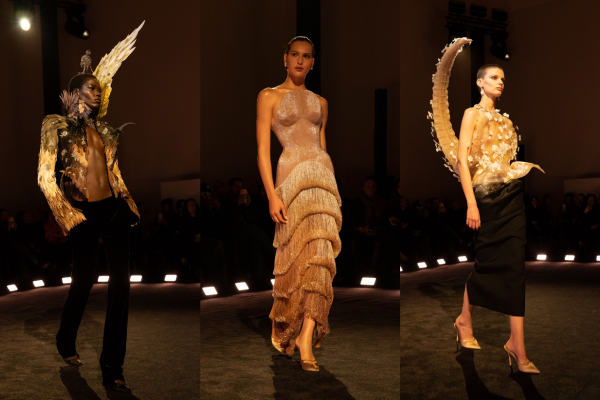
Schapiarelli
Daniel Roseberry’s couture has always flirted with fear—of the body, of beauty, of excess—but this season, he leaned into it fully. After visiting the Sistine Chapel and staring up until awe tipped into unease, Roseberry returned to the atelier and began sketching what frightened him. The result was a procession of what he called couture’s infantas terribles: scorpion tails, beaked pumps, horned silhouettes and reptilian textures, rendered not as costume but as precision craft.
There were nods to last year’s Louvre jewellery heist (the most chic crime we’ve seen in decades) and more than a few critics reached for McQueen comparisons. But what made the collection land wasn’t provocation alone; as always in couture, it was the sincerity of the workmanship beneath it. Satin stitch masquerading as crocodile skin. Lace sculpted into bas-relief. Thousands of hand-painted feathers stacked into something approaching hallucination. It felt like Roseberry doing what Schiaparelli does best: taking the grotesque seriously and beauty lightly, until the two become indistinguishable.
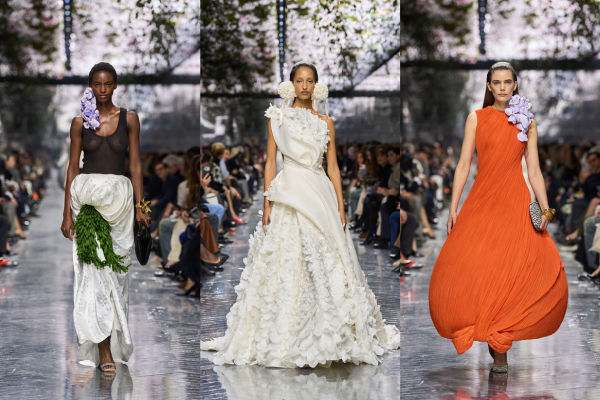
Christian Dior
Jonathan Anderson’s first couture collection for Dior arrived carrying more than a little emotional baggage, following what some have called a confused menswear runway last week. But here, at the Musée Rodin, something recalibrated. Beneath an inverted meadow of cyclamen—suspended overhead like a dream turned inside out—Anderson presented a vision of Dior that was distilled, not diluted: sculptural, precise, oddly tender.
The opening looks nodded gently to the New Look without becoming trapped by it, their bell shapes pared back to something abstract, a curiosity about the potential of the feminine form. Throughout, the collection played with the tension between real and unreal: feathers that weren’t feathers, florals that felt more ceramic than botanical, historical fragments embedded into jewellery and accessories like relics reassembled for the present. Couture here wasn’t nostalgia, nor spectacle for its own sake, but experimentation in its most disciplined form. Less a debut from Anderson (although that was still heavily apparent throughout) than a quiet thesis on what Dior could become when freed from reverence to itself.
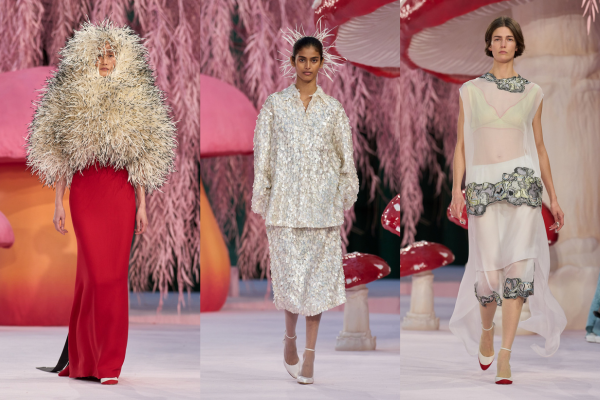
Chanel
Under Matthieu Blazy, Chanel finally feels like it can breathe. This season’s show at the Grand Palais unfolded beneath towering mushrooms and willow trees, a landscape that set the tone for what followed: softness, lightness, and a sense of release from the house’s own mythology. The tweed suit remained, but rendered with curiosity, more porous, almost vulnerable. Less armour, more suggestion.
Rather than rewriting Chanel’s codes, Blazy loosened them. Love letters appeared embroidered into linings, handbags turned transparent, lipstick charms swung from chains. Birds became the central motif—not literal feathers so much as impressions of flight, movement, and lift—with silhouettes that skimmed rather than structured the body. The result was couture that was intimate rather than monumental, and strangely emotional in its restraint. For the first time in a while, Chanel wasn’t performing itself. It started to listen.
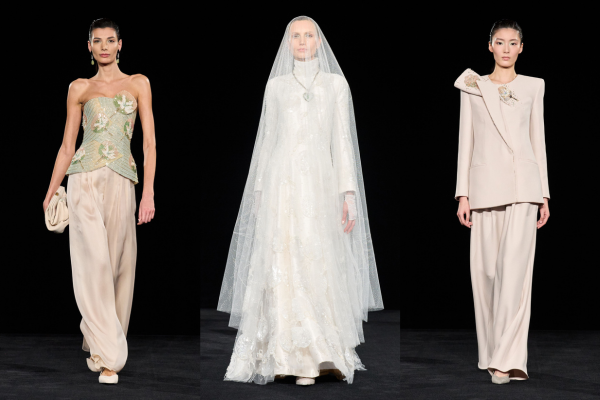
Giorgio Armani Privé
It is moving how little Giorgio Armani Privé has changed, and how right that feels, now. In the five months since Armani’s passing, the house’s couture arm has remained devoted to the quiet glamour and disciplined elegance he spent decades refining. Under the guidance of Silvana Armani, his niece and longtime collaborator, this season’s collection felt formative and true with jewel tones (read: jade greens, soft pinks, pale aquamarines) cut into fluid suits, column gowns and architectural jackets.
Motifs of hand fans were found across embroidery and necklines, while sculptural jackets made from weighty embellishment gave way to weightless pleats that closed the show. The final wedding dress—one designed by Armani himself for his last Privé collection but never shown—was the continuity we craved. Couture week, after all, can easily become obsessed with its own reinvention. Armani Privé then was a gift of something rarer: the reassurance that without Giorgio’s vision, the essence of him remains.
Valentino
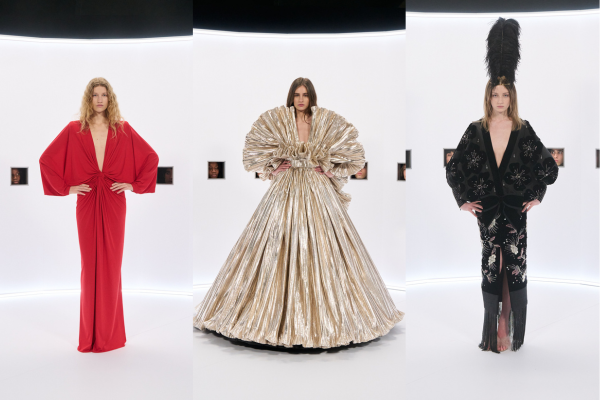
Alessandro Michele’s Valentino couture show veered away from runway, and instead became a devotional act. Staged inside twelve circular rooms, guests peered through tiny apertures—kaiserpanorama-style—to glimpse the collection in fragments, as though worship required both distance and focus. The format alone would have been memorable. But arriving less than ten days after the death of Valentino Garavani, the collection took on a gravity that Michele promised to honour rather than resolve.
The opening crimson gown, unmistakably Valentino red, was benediction. From there, Michele’s baroque instincts unfurled: Elizabethan silhouettes, Deco showgirl references, haloed headpieces, jewelled surfaces and operatic proportions that bordered on devotional excess. Of course, as with Michele’s metier, beneath the spectacle was a surprising tenderness: this wasn’t about replacing a myth, but learning how to stand beside one. Michele’s post-show tribute made that explicit: legacy, here, wasn’t something to update or overwrite. Valentino’s legacy is something to hold with careful reverence. And this he did with valour.
Advertisement