How Assouline Turned the Coffee-Table Book Into an Object of Art
For three decades, luxury publishing maison Assouline has redefined the coffee table book, transforming literature into a tactile masterpiece of design—a globally recognised objet d’art. This is the conscious vision, of founders Martine and Prosper Assouline alongside their son Alexandre, who see the book as an object first—something that entices the reader to pick it up and explore, with the content discovered only upon opening. Monica Tischler spoke with Martine Assouline about this enduring philosophy.
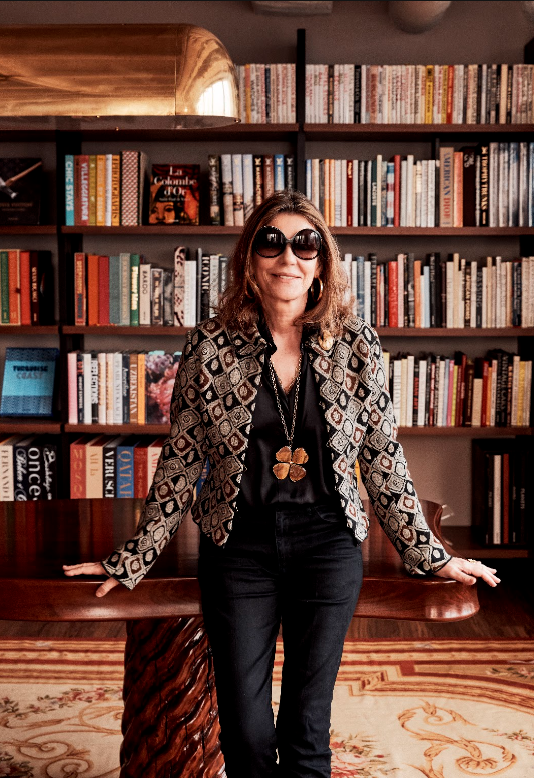
While the interior pages are undeniably beautiful, spanning the candy-coloured Travel Series, with its evocative photography of dazzling destinations, to the immersive journeys of the Ultimate Series, where the Formula 1 volume even greets readers with the faint scent of burnt rubber — it is the covers of the Assouline collection that stand as the true artistic centrepiece.
‘As Prosper says: “After all, a book spends most of its life unopened, so it’s important that it be a beautiful object,”’ Martine explains, affectionately referencing her husband’s adage while highlighting the collaborative family approach that defines their brand.
From the modest beginnings of their Paris basement in the early 1990s, the husband-and-wife team launched their inaugural volume, La Colombe d’Or, inspired by their favourite hotel on the Côte d’Azur, French Riviera. Martine composed the text while photography was done by Prosper. Another early release highlighted the pair’s appreciation for childhood curiosity, featuring a collection of their youngest son Alexandre’s childhood sketches detailing visits to Parisian museums.
Under Martine’s astute creative direction, Assouline has evolved into a global authority on travel, art, hospitality, design, and more, now boasting 2,000 titles and releasing 100 new volumes annually. Each hand-bound edition is crafted with the same reverence and precision as the haute couture garments it so often documents.
A recent addition to the Travel Series brings references closer to home in a detailed look at Captain James Cook’s voyages of exploration across the Pacific Islands. It’s a subtle shift in how the tomes are evolving, taking readers on a deeper journey of discovery. ‘We are now starting a book about Ernest Hemingway during an important moment in his life in Cuba, and discovering places through his story, in his words,’ Martine explains.
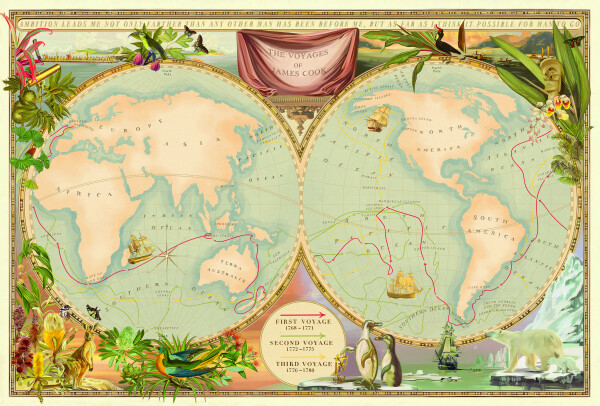 Image by Amy Elena Nash.
Growing up amidst the vibrant landscape of Africa’s Ivory Coast and later within the heart of France before settling in New York, Martine’s intrinsic connection with literature took root early, though its nature has undergone a profound metamorphosis.
‘When I was young, the text would lead me to the images; now it is the contrary. You can say something with the visuals, and then you’re attracted to knowing more and visiting the place.’
She speaks openly about a time just prior to launching Assouline—a moment she discovered a book in Prosper’s apartment—describing it as the beginning of their story together, both figuratively and literally. Auspiciously titled The Decisive Moment by Henri Cartier-Bresson, its imagery and design both fundamentally reshaped how she viewed and engaged with books.
‘I was suddenly more concerned with images than words. My life before was textbooks, you know, and then the images became like poetry and pivotal to understanding the situation. The group of images together provided emotion. The design was perfect—very simple, without classicism. All of that participated in what was a very crucial moment.’
Embodying the ethos that a child’s curiosity shapes a legacy, Alexandre has expanded the Assouline offering to include library accessories such as scented candles, bookstands, and bookends alongside their online magazine and podcast, Culture Lounge. Amidst this evolution, I’m curious about whether the rise of technology threatens traditional, physical media.
‘No. A book is a book,’ Martine affirms. ‘And we now make the books with a better technical approach than decades ago. The materials, the paper, the fonts, the colours, the textures, the way to emboss—the more sensitive you are to those, the better you can do it.
‘People are attracted to and need tangible things that have a good approach, which is at once both knowledge and emotion. I completely think it’s what we need. I think education is very important—to open your mind, to change your point of view, to see different people and the way they express themselves, and the way traditions continue. All of that is so important. The way we try to make the books is to take somebody by the hand and offer them something.’
Martine admits the process is often painstaking. She hand-draws each cover in the Travel Series, personally selecting the colours and shaping those perfectly imperfect, organic forms—a creative ritual she often performs to music. The resounding success of the final, tactile result, however, speaks for itself.
‘You have to fill yourself with the subject and try to understand the place, the past, and the soul of today. And then, choosing the right title is very important. The cover involves a lot of testing. We are very difficult here, as the people who work with us know! We focus on the details; sometimes we’re a bit crazy if a detail isn’t right or the colour isn’t exact, and so multiple tests on the cover are necessary.’
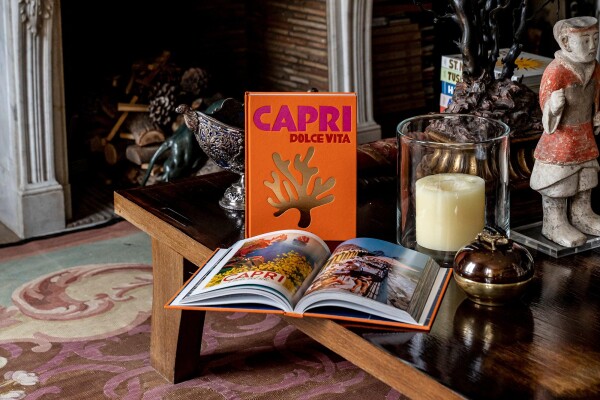 Capri Dolce Vita published by Assouline.
Seeking out beauty has long been the north star in Martine’s life—a philosophy vividly mirrored across the pages of her namesake volumes. Yet, in a world that can often feel far from beautiful, how does she remain so steadfast to this vision?
‘It’s a question I have to ask myself so many times when I see the world changing. Maybe I have to choose what I see. Beauty is a trajectory, but it’s also an answer to life. If you want beauty, you can find it. You can find it in nature, in animals, or in a good person. You can also find it in a text, an image, or in a beautiful hotel with a view. Even in your office or apartment, each detail is important. Choosing an office for us has always been about having a view,’ she says as she fondly recalls the original Assouline headquarters, where extraordinary sunsets reflected off the Hudson River.
Today, situated in the heart of Manhattan, the workspace offers a different kind of inspiration: ‘We overlook the Chrysler Building; it’s incredible—you know immediately that you’re in New York. The space is designed like a home, because you must curate your life as a positive, beautiful experience.’
Martine’s eyes light up whenever she talks about the city that left a lasting impression when she first visited with her parents as a teenager. It is fitting, then, that her favourite title is New York by New York, from her Legends Collection. ‘It’s the one that I go back to. It details the unique cultural story; the society, the architecture, the music, art— everything. The cinema of the city, too, because New York is a continuous film.’
If New York is a cinema, then how would the pages of a volume detailing Martine’s own life story unfold? They would, she suggests, reveal themselves like a cartography of the heart, an ode to the global tapestry of friendships and memories that define her journey. From her African roots and Parisian chapters to her present life in New York, her narrative is a map of collected moments.
‘My life has been in so many countries. I still have family in Africa. I love the country and its people; they are so joyful. My [eldest] son lives in Greece. My grandmother was half Greek and half Russian. I have friends in South America and understand its spirit in a second. I can’t tell you everywhere I’ve been.’
For Martine, the story is never truly finished: ‘All of that is a mix of what makes me who I am. I think that life is made of moments. The very important moments make you; they stay in you and make up your identity. Sometimes you’re alone; sometimes you participate. From one moment to another.’
Advertisement