
How Booking.com's Travel Proud programme is making travel safer for LGBTQ+ guests
Earlier this month, Remix travelled to Amsterdam for WorldPride to explore a question that still shapes how many LGBTQ+ people experience the world: when you arrive somewhere new, how do you know you’ll be welcomed?

At the centre of that conversation is Booking.com’s Travel Proud programme, an initiative designed to help accommodation partners create more inclusive experiences for LGBTQ+ travellers. The visit included conversations with the team behind the programme, a look at its work during WorldPride, and insight into how the travel industry is responding to the demand for safer, more inclusive journeys.
Courtney Act has spent much of the past few years on the road as Ambassador for Travel Proud. Before taking to the stage in Amsterdam, the Australian drag superstar reflected on the role Pride events continue to play as gathering points for the LGBTQ+ community.

‘These events are sort of like a homecoming,’ she says. ‘We always get to hang out and see each other and have a good time in the dressing room as well as on stage.’
Earlier this year, Courtney put the programme to the test herself, using the Travel Proud filter while booking a hotel for a friend’s wedding in Milwaukee, Wisconsin. She admits she had pre-judged the city as small and buttoned-up.
‘I used the Travel Proud tick box to find a hotel. And when I got to the hotel, not only were they delightful, but there was also a sign that said there was a drag brunch happening tomorrow morning in the restaurant upstairs, and my friend Candy Stratton was performing. I was like, ‘Well, this IS a very Travel Proud hotel!’’
The programme’s origin, Booking.com Global Communications Director Kristofer Barber explains, came from a simple rethink of the company’s mission: ‘making it easier for everyone to experience the world.’ ‘It was really that ‘everyone’ bit that kind of unlocked some different thinking and curiosity within our team,’ he says.
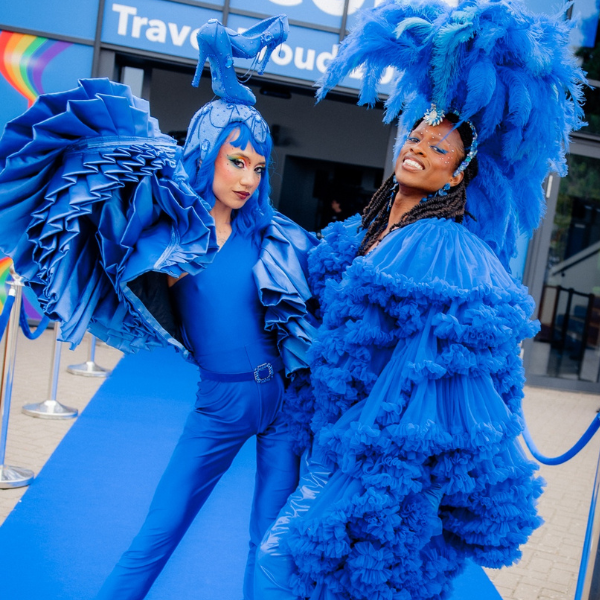
That curiosity became Travel Proud: a free training programme for accommodation partners focused on helping staff better understand and support LGBTQ+ guests. Once completed, properties receive a Travel Proud badge on their listing, giving travellers a way to identify places that have made a commitment to inclusion.
Research behind the programme found that many LGBTQ+ travellers still worry about judgement when travelling. For those travellers, knowing a property has completed the training can make the difference between feeling uncertain and feeling welcome.
For Kristofer, the impact is best seen in everyday moments. He recalls an encounter in a hotel lift with a trans woman who appeared uncomfortable and on edge. A simple compliment about her shoes broke the ice, and later he watched as hotel staff naturally used her correct pronouns while assisting her at reception. ‘It was a secret shopper moment,’ he says. ‘I got to see our training come to life… she was treated with the same respect as everyone else.’

The programme also recognises that visibility is not always straightforward. In some countries and regions where LGBTQ+ identities are criminalised, the Travel Proud badge is not displayed, prioritising the safety of both travellers and accommodation partners. As Kristofer explains, inclusion has to reflect the real-world conditions people face.
New Zealand and Australia were among the first markets where Travel Proud expanded outside Europe, with New Zealand’s programme including Queenstown Winter Pride activations supporting OutLine Aotearoa, the local queer helpline service.
Travel Proud is not positioned as a solution to every challenge facing LGBTQ+ travellers, but it offers something many have not had before: a clearer way to identify accommodation providers that have actively done the work.
Fittingly, Courtney’s advice for travellers is simple: plan ahead, but leave room for discovery. ‘My number one travel tip is to plan, because I don’t,’ she says, describing friends who pin restaurants and one daily experience to a shared map rather than over-scheduling. Her favourite example was a socio-political walking tour through Athens. ‘You get to learn about the history of the city and you’re wandering around inside of it… wandering out to a high street in any city isn’t really experiencing the city.’
Because ultimately, the best travel experiences are the ones where the only thing you have to worry about is the sights you’re seeing, or what you’re having for dinner, not whether you’ll be accepted when you arrive. About time for a change, we think.
Advertisement