Meet the winners of the 2025 Lexus Design Award
Tucked at the bottom of the world, New Zealand is often labelled ‘small’—a tiny dot on the map, far from the global noise. But in design, small is no longer a limitation; it’s a competitive edge. It’s this very spirit that Lexus seeks to celebrate and elevate through the Lexus Design Award; a programme built around nurturing ideas with genuine social and environmental impact.
“Sustainability and design are core to Lexus,” says Andrew Davis, Vice President of Lexus New Zealand. “This award is about profiling concepts that push boundaries and giving emerging designers real opportunities — mentorship, exposure, and a platform to launch their careers.” Now in its sixth year locally, the initiative continues to spotlight homegrown talent, offering cash prizes and invaluable guidance from some of Aotearoa’s most respected design voices who have been in their very shoes.
As Lexus Design Award judge and mentor Paddy Kennedy of Acme CupCo explains, being “small” is our superpower — a unique advantage when navigating the complexities of creating and taking products to market. It allows us to stay nimble, stay curious, and, as fellow judge and design pioneer Simon James adds, it equips us with a deeper appreciation for sustainability-led design, having witnessed first-hand the impact products can have on the big, beautiful backyard we call Aotearoa.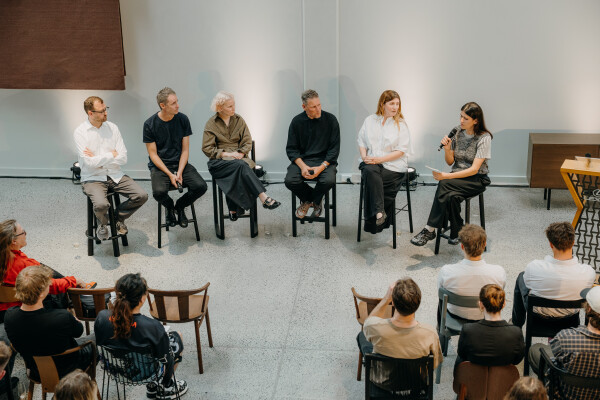
Both Paddy and Simon embody that Kiwi-honed instinct. Each has become a leading voice in New Zealand’s design landscape — Paddy through Acme CupCo, Simon through his eponymous brand and as co-founder of Resident. This year, they join an expanded panel of judges and mentors: Megan Wyper of Acme CupCo; Gosia Piatek, founder of ethical fashion label Kowtow, and her Managing Director Emma Wallace; and Resident co-founder Scott Bridgens. Together, they lend their expertise to guide and elevate the next generation of design thinkers for the 2025 Lexus Design Award.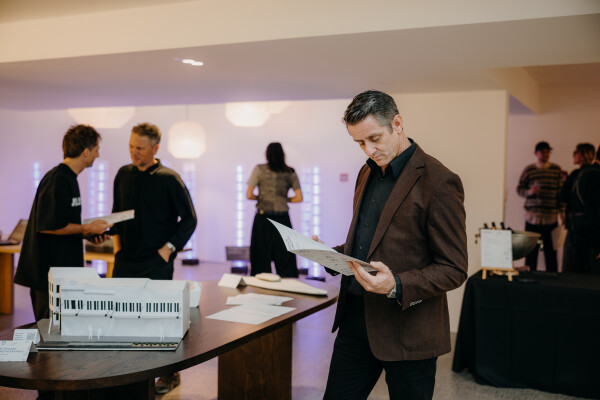
The university-honed programme remains a crucial platform for curious minds to turn ideas into reality. Entrants are encouraged to think boldly and propose sustainable, design-led solutions that address real-world challenges with a vision for a better future. The brief is intentionally open-ended, inviting unfiltered interpretation, but every submission must embody Lexus’ core principles — Anticipate, Innovate, Captivate — and, since 2024, align with the United Nations’ Sustainable Development Goals. It reflects Lexus’ continued commitment to sustainability, with over 80% of its New Zealand vehicle sales now electrified.
For 2025, the awards mark a series of exciting firsts for Lexus Design Award. Wellington’s Victoria University and Massey University join the long-standing participants AUT and the University of Auckland, widening the net for emerging talent and inviting even more design-savvy thinkers into the fold.
As mentioned, the judging and mentoring panel has grown — a decision driven not only by geographical expansion, but by necessity. Speaking at the Auckland awards night, judge Scott explained that design is inherently subjective; we each see the world differently. Bringing four new mentors into the programme broadens the lens. It fuels richer, more considered conversations about which entries best answer human needs while championing forward-thinking design — qualities deeply embedded within Lexus itself.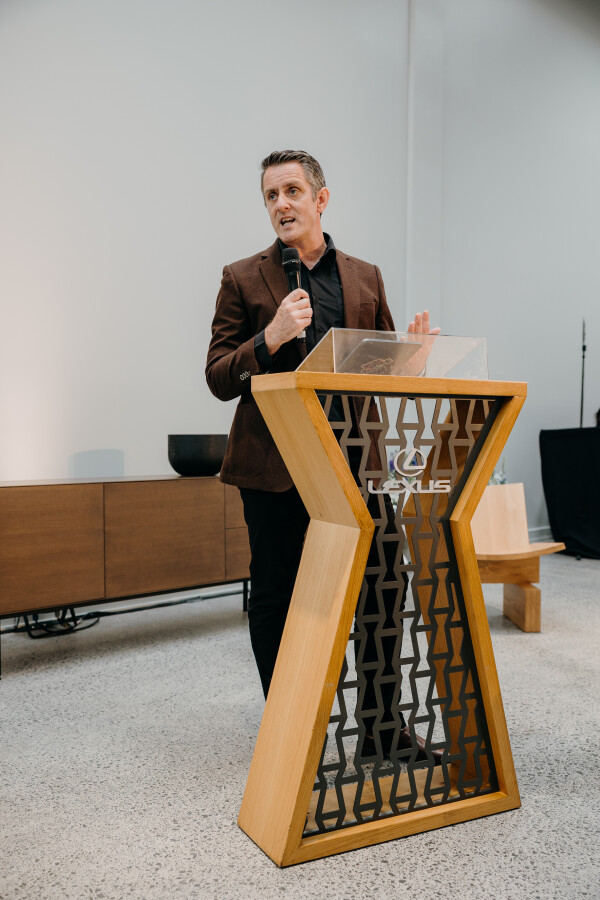
Andrew Davis, Vice President of Lexus New Zealand
This sixth year also welcomed a record 90 entries. On paper, it’s a notable growth. But more importantly, it reflects an innate desire within Gen Z: a genuine want to make a difference to the world we live in and the people who inhabit it. It mirrors the ethos of brands like Kowtow, whose philosophy — “leave the planet better than it is now” — threads through every plastic-free, ethically crafted garment. As judge, mentor, and Kowtow Managing Director, Emma Wallace explained, this same thoughtfulness was evident across the submissions; entrants considered their resources, their impact, and the environmental footprint of their ideas.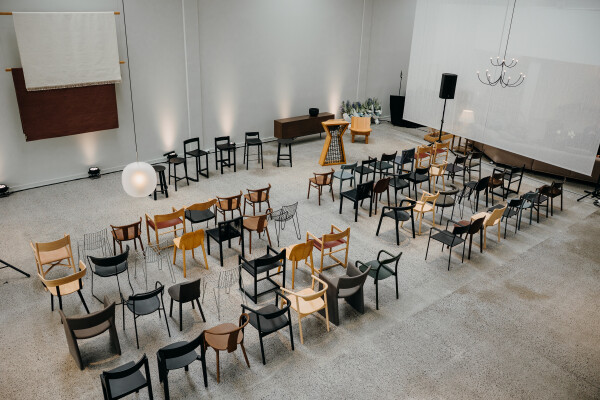
After Wellington hosted its inaugural winners’ showcase on Tuesday evening, Auckland presented its own winners and runners-up the following night — an intimate ceremony held within the considered surrounds of the Simon James Mount Eden showroom.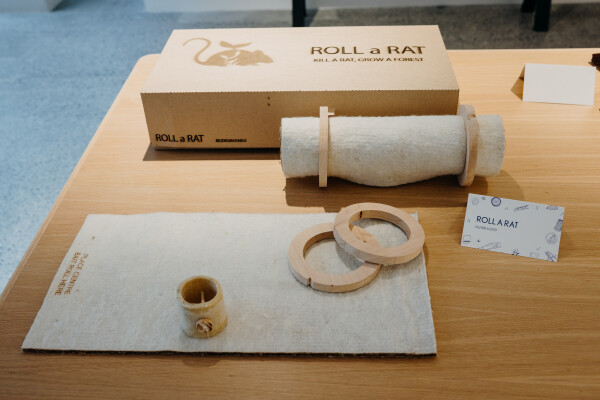
AUCKLAND UNIVERSITY OF TECHNOLOGY (AUT) WINNER
ROLL A RAT BY OLIVER LLYOD
When the Government announced its goal to make Aotearoa pest-free by 2050, it sparked both optimism and understandable scepticism — could such an ambitious target truly be met within such a short timeframe? Ambition aside, the initiative sparked important conversations and, crucially, inspired innovation that continues to drive progress forward. AUT student Oliver Lloyd seized that momentum and asked how design could meaningfully accelerate pest-control efforts. The result is Roll a Rat, a clever, sustainability-led solution to one of conservation’s most labour-intensive challenges. Currently, the Department of Conservation sets rat-bait stations throughout native bush to protect wildlife from introduced predators — but every station must be manually collected, tracked, and replaced. Roll a Rat directly addresses this problem. Designed as a flat-pack, fully biodegradable bait station, it not only helps control invasive rodent populations (specifically the Norway rat) but also supports ecosystem regeneration by including native seeds.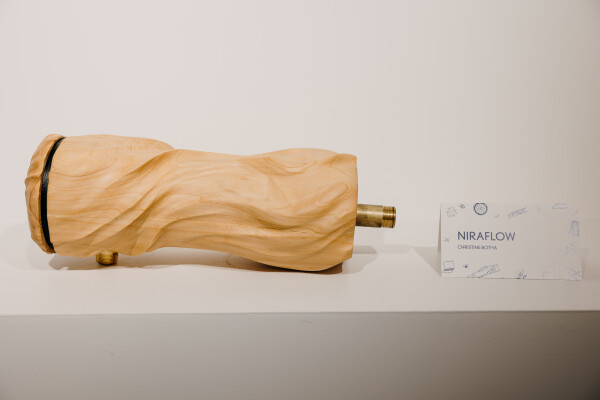
AUCKLAND UNIVERSITY OF TECHNOLOGY (AUT) RUNNER-UP
NIRAFLOW BY CHRISTINE BOTHA
Greywater is an everyday by-product of modern living — yet hidden within it are microplastics that quietly accumulate in our waterways. Seeking a simple, scalable way to intercept the problem at its source, AUT’s Christine Botha developed NiraFlow, a wool-based greywater filter that captures microplastics before they reach the environment. Mounted on an exterior wall and connected directly to a home’s greywater outlet — such as a washing machine or shower system — NiraFlow uses gravity to draw water through stacked layers of New Zealand wool slowly. The fibres trap microplastics of varying sizes while allowing filtered water to pass through, offering an accessible, low-impact alternative to more complex filtration systems. Christine tells me that the wooden sculptural form was intentionally shaped to mirror the natural downward flow of water — creating a functional object that also becomes something you’re proud to display at home.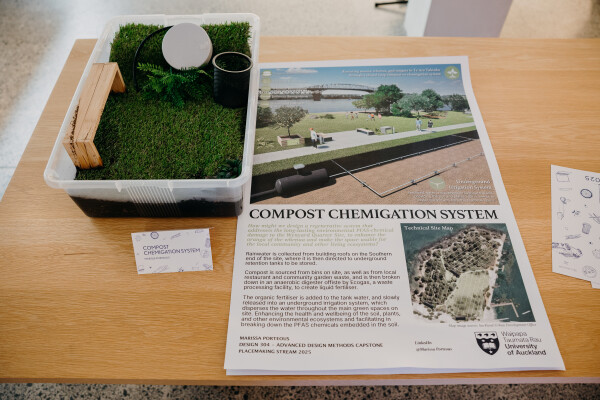
UNIVERSITY OF AUCKLAND WINNER
COMPOST CHEMIGATION SYSTEM BY MARISSA PORTEOUS
Once the site of the former Shell Gasworks, Auckland’s Wynyard Quarter still bears the impact of PFAS chemicals long embedded in its soil. Marissa Porteous set out to design a solution that actively helps restore the whenua. Her Compost Chemigation System proposes a closed-loop network beneath Wynyard’s green spaces: rainwater collected from nearby rooftops is stored in underground tanks, blended with organic liquid fertiliser made from local food and garden waste, and slowly released through an irrigation system to help rebuild soil health and support the gradual breakdown of contaminants. 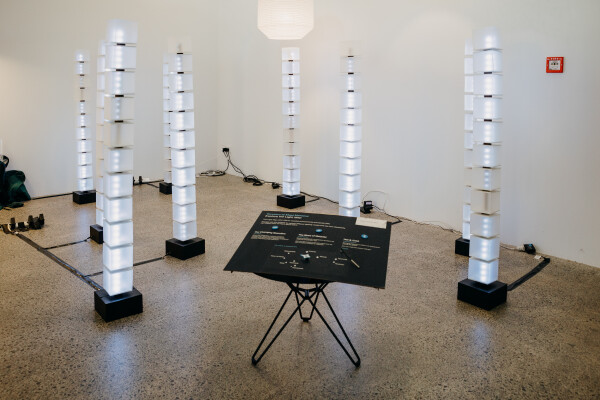
UNIVERSITY OF AUCKLAND RUNNER-UP
THE LIGHT MAP BY OLIVIA LEE
By day, Aotearoa’s urban parks are buzzing with life; by night, those same spaces slip into darkness, leaving many to take the long way home rather than risk the shadows. To counter this, University of Auckland runner-up Olivia Lee designed The Light Map — a modular light sculpture that invites people back into parks after sunset. The installation encourages interaction, illuminates artwork, and transforms public spaces into safer, more welcoming environments after dark.
LEXUS.CO.NZ
Advertisement