In conversation with Jesse Woolston: The Kiwi artist’s long-awaited homecoming
After a sold-out event in 2025, Art in the Park is returning to Eden Park this November 12–15. The exhibition will bring together more than 140 emerging and established artists and over 3,000 artworks for a world-class celebration of New Zealand art.
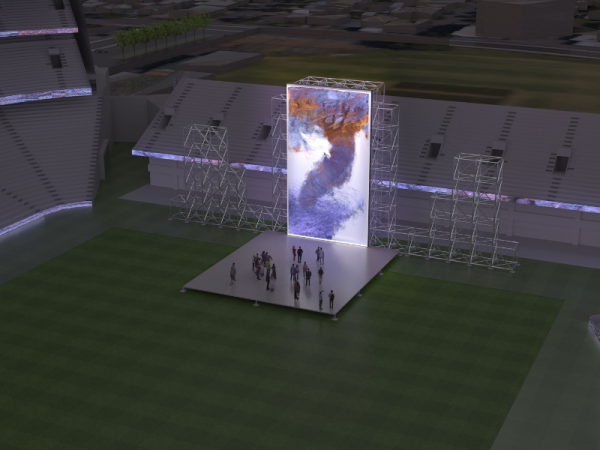
Leading the 2026 programme is the internationally acclaimed artist Jesse Woolston, known for creating immersive, large-scale works inspired by the beauty, power, and unpredictability of Aotearoa’s natural environment. Since moving to the US at 21, Woolston has built an international career working with major art organisations and global brands, creating experiences that feel as though nature itself has been captured within a living sculpture. Woolston's installation, The Infinite Constant Front, will transform the field into an immersive encounter with the landscapes that continue to inspire his practice from across the Pacific.
To celebrate his New Zealand debut, Remix caught up with Jesse to discuss his creative journey, his connection to Aotearoa, and the vision behind Art in the Park.
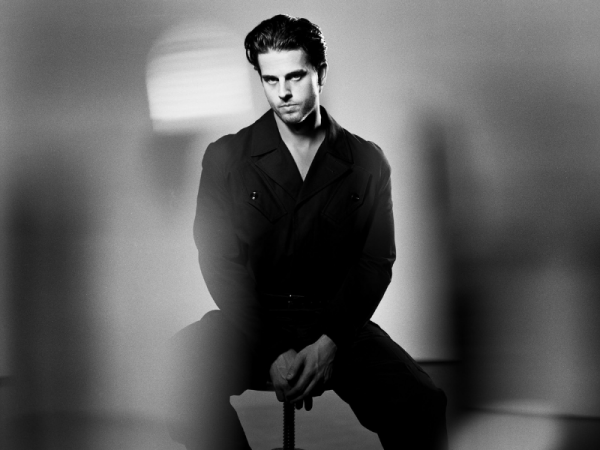
This is your first time exhibiting your immersive artwork in New Zealand. What does it mean to bring your work back to the country that shaped your artistic language?
It’s actually everything because I’ve been waiting 13 years for a moment to come back. If I think about my entire practice and everything I’m doing, most artists follow the path of going to school, getting the information, language and tools to make their work. Usually, people do that. For me, I had none of that. So I thought, all right, great, what do I have? The one thing I’ve had that’s been the most powerful driver and knowledge base for my practice has been home — the feeling I have with nature and how connected I am to it.
It’s been such a powerful language that I never really needed anything else. So for me, this is a really interesting moment where I’ve run off, built some installations, done some projects, and now I get to come back. It’s like returning to the place that gave me everything.
Are there any specific locations or natural phenomena in Aotearoa that have been particularly influential for you?
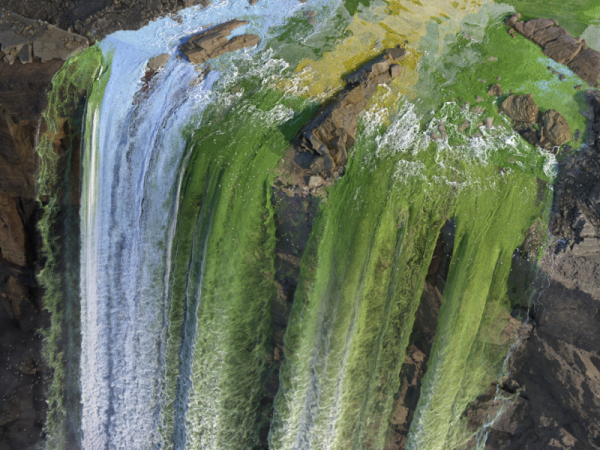
Well, over the last couple of years I’ve been doing these trips to gather source material. I’ve been focused on the North Island and the East Coast, making my way around to collect different waterfalls and rivers. Waipiro Bay, up near Gisborne, has been really important. There’s one in Te Puke that took me about two hours to find, and it’s quite small. But despite all the waterfalls and locations I’ve visited around New Zealand, it always comes back to the big one: Piha. The classic.
Of course.
What’s funny is I’ve been gathering this source material for years, and I see it throughout all my work. No matter what project I’m working on, I think, Oh, I know what inspired that. I’ll go back to the videos and recordings, and I’m like, Yep, that’s where it came from.
Your work combines computational simulation with physical materials and colours from the natural world. Is there an ideal balance or relationship between technology and the environment that you try to emulate?
Whenever I try to make something, it has to have a purpose. I don’t just make things for the sake of making them. I’ve never really been able to do that. So if I want to make a waterfall, I have to capture the real waterfall and then simulate the entire environment so that when it runs, you only see a portion of it, but it still feels like it belongs to a much larger ecosystem.
Then I ask myself, Okay, what’s the point of this work? The point is to give people a moment with nature, with these waterfalls. From there, I look at what other senses I can engage to make it a more potent experience. So I use the highest-resolution rendering and lighting I can. I use a container so people feel like they’re looking at a specimen or a fragment, and then I use colour to guide the eye.
It’s like when you’re swimming and you put your head underwater. The water is transparent, so you can’t really see any of the movements. By using colour the way I do — creating abstract paintings, which are awful, awful paintings, and then coding them into the simulation — the water picks up those colours and carries them through the flow. If you look at a blue, you’ll see it at the top and then all the way down to the bottom. The same happens with reds, purples and everything else. So, I actually use colour to allow people to follow what’s actually happening in the phenomenon they’re looking at.
All of those colour palettes are inspired directly by the places I love. I got a little nerdy at one point with the tornado piece, where I was taking the colour of the soil from the exact moment the tornado occurred. It’s like, Come on, man! [laughs]. I’ll look at an environment and try to figure out how I can make the work feel as direct as possible to the inspiration, which is nature and the phenomenon.
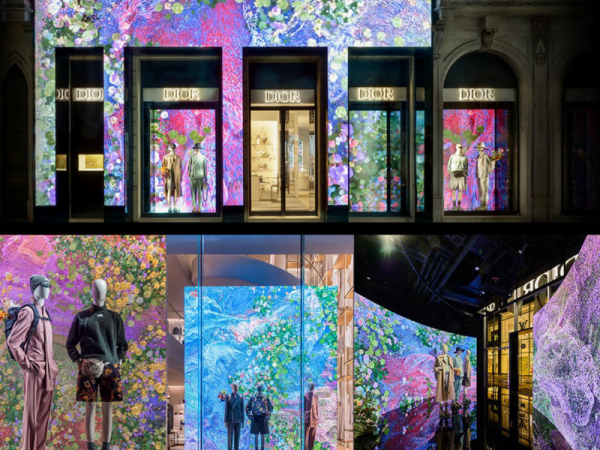
You’ve worked with major art organisations and brands overseas, including fashion houses like Dior. Does that work influence your independent practice or push you creatively in different ways?
Yeah, I’m very lucky, and I think this is a technique that might be useful for other artists. With projects like Dior, they reached out to me, we had a couple of meetings, and I already knew what I wanted to do. I was so inspired by their collection and what they were talking about that I simply showed up with the work I wanted to make. They were like, Great, do it.
Easy.
Yeah, exactly. What was really cool about that project was that I got to treat a commercial environment like an art project. So yes, it absolutely pushed me creatively. I became much better at building simulations because I was working from a completely different source of inspiration, like Christian Dior’s pond at his home where he designed dresses. I thought, Okay, that’s different. Who would think that would be a source of inspiration?
That’s been incredibly useful, but so has testing my ideas in different environments, whether it’s film, fashion or architecture. It allows me to test myself — Do I actually know what I’m doing? If I do, I can navigate those different arenas.
And then you can do something else on top of that.
Exactly.
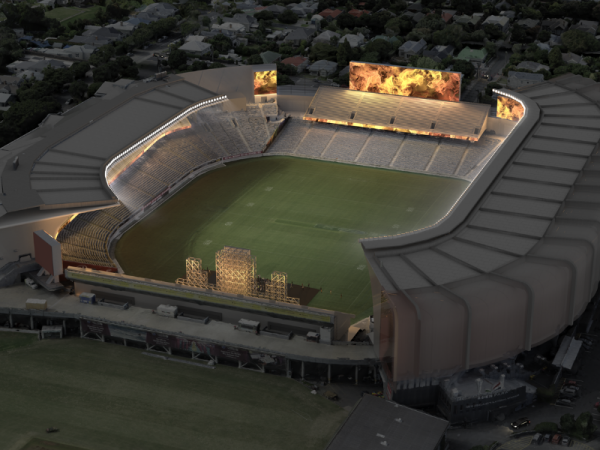
You’re presenting at Art in the Park, which is one of New Zealand’s most anticipated cultural events. What role does it play in bringing together Aotearoa’s artistic community?
The thing that jumps out to me most is that there’s no other place on this planet that’s like, yeah, we’ll just turn this stadium into an art gallery.
Yeah, I love it.
It’s so Kiwi, isn’t it? Like, why not? Let’s do it. The fact is, this just doesn’t happen anywhere else, and I can say that with full confidence. The fact that there’s a bunch of Kiwis in one location — the national stadium — saying, Let's do it, is amazing.
Then there’s the fact that they’ve been such strong advocates for the arts. They’ve brought together artists from so many different regions and areas across the country, even reaching out to someone like me who works in a completely different space. That’s just amazing. That desire to bring Kiwis together and celebrate New Zealand art is really important.
It’s what makes me so proud, too. If I came back just to do an independent installation, it would be incredible. I’d love it and be so happy for it. But the fact that I get to be part of a group of artists that celebrate the same language — that’s what I really want. That’s great.
If there’s one feeling or idea you want people to walk away with after experiencing this installation, what would it be?
You know what? I just want them to feel it. However they do, whatever that means for them, I just want them to have that connection with themselves and ask, What does it mean to stand in front of this natural phenomenon? How do I feel about nature and the environment? What do I feel when I’m standing in front of this canvas?
I want people to have the arena to have a moment with themselves. That’s what I want. I don’t want people thinking about me. I don’t want them thinking about anything other than, Oh, this is beautiful or Oh, I hate this [laughs]. That would be it.
Tickets to Art in the Park are available from Tuesday, 11 August here.
Advertisement